
Summer 2026
2
A Question of Literary Activism
A Question of Literary Activism

Jennifer Elise Foerster
RWW Faculty
A day does not pass that I don’t ask this question: How is my engagement as a poet in the world, as a teacher of poetry and literature, as a reader and writer, participating in the work I deeply believe we as humans need to be doing right now?
This work, for me, involves two overlapping attentions:
First, fighting for life for seven generations into our future. This is not just a fight for human life; it is a fight for the thriving of all life-forms seven generations into our future, as we are not human without air, water, bacteria, a biodiversity of species, the energy of the sun, or the life of the plants.
Second, fighting for justice in a regime that has turned away from justice, from compassion, from respect for diversity and human rights.
I believe it is essential to know where we come from, and as writers, this also includes understanding our various literary inheritances.
Since the Civil Rights movement, more and more of the real voices and stories that compose this nation called the United States have been breaking through two centuries of colonial suppression. But what has thrown up its defenses in recent years is a persistent nationalist story, one that was designed as a story of righteous heroism to preclude anything that threatens it, a story sponsored and funded by capitalism, neoliberalism, and authoritarianism. Major institutions are now, more than ever, sanctioning the censorship of truths, thereby promoting the propaganda of the state that refuses to acknowledge its violent past and present, its insidious culture of racism, and its exploitation, for the gain of the wealthy, of the environment that sustains all life on earth.
One of these suppressed realities is our accelerating path toward self-extinction.
I am haunted by the question, articulated by artist and geographer Trevor Paglen but posed by many: What does it mean that we “know exactly how we’re killing ourselves, and . . . going ahead and doing it anyway”? (Schmelzer) Self-sabotage is one thing; this is extinction beyond imagination. Perhaps our failure of imagination is the problem.
Amitav Ghosh, an Indian writer of fiction and nonfiction, has written in his book The Great Derangement: Climate Change and the Unthinkable:
I have come to recognize that the challenges that climate change poses for the contemporary writer . . . derive ultimately from the grid of literary forms and conventions that came to shape the narrative imagination in precisely that period when the accumulation of carbon in the atmosphere was rewriting the destiny of the earth. (7)
In Ghosh’s criticism, he points out that the realist novel does not account for the reality of our biosphere’s catastrophic turbulence, the transformations in climate that are causing unpredictable and irregular calamities in our lives. Storytelling conventions of the last century, he points out, can’t hold the “unimaginable events of our era.” (33)
The scope and cascade of effects from climate change catastrophe are overwhelming to conceive. But capitalism and neoliberalism, which are primary frameworks driven by the Global North and our institutions, demand conventions that make these effects almost impossible to conceive. The core mechanisms of capitalism include values such as economic expansion, which fuels resource extraction and consumption. Short-term market rewards are favored over long-term stability, as are the notions of individualism over collectivism, externalization of costs, the off-loading of production impacts, and ultimately the commodification of ecosystems, including people, as tradable assets. These mechanisms are justified by neoliberal ideology, an ideology where citizens are consumers, freedom is market liberation, and resources are exclusive property that can be accumulated, and those who accumulate them, not those who don’t, are protected by state and private interests; violence ensures this. In this kind of system, genocide, poverty, inequality, and disproportionate climate impacts are assumed as a kind of natural and inevitable by-product.
But it doesn’t have to be this way. As writers and artists, we should know—and believe in—the power of imagination, the power of story, to both persuade and effect change. As the writer and environmental activist George Monbiot reminds us, neoliberalism is just a story. But the impacts are powerful and real. It is largely because of these systems of wealth and resource looting that our time is one of strengthening ecological cataclysms, of global biospheric transformation; we increasingly experience the effects of “tipping points” or “feedback loops” that are the results of global temperature rise. Our time is one of accelerating biodiversity loss, “unnatural/irregular” human and non-human animal migration patterns, widening food deserts, and resource scarcity, to name just a few devastating effects.
I believe the challenges posed by our climate crisis necessitate a new story. While this may seem like a passive idea, I think our crisis also necessitates a re-evaluation of our literary practices. Does our time not demand of us a deeper contemplation of the way we exist within our environment and how our sense of ecology is perceived? Does our time not demand of us a consideration of what we mean when we say nature? When we think nature? How we write nature? It seems imperative that as writers we consider how the notions of “nature” have shaped and been shaped by literature, particularly the literature of the nation (which also means the institutions, audience, politic, and language) within which we write.
Timothy Morton, author of Ecology Without Nature, wrote: “The idea of nature is getting in the way of properly ecological forms of culture, philosophy, politics, and art” (1). What might he mean by “properly ecological forms”? If “ecology” refers to our understanding of home, then ecological forms of culture, philosophy, politics, and art, I think, must acknowledge the complexities of human and beyond-human life-forms, our relationships within planetary (our home) ecosystems. Other-than-human ecosystems are not void of social, political, and economic factors, nor are they void of language. Properly ecological, then, must not generalize “nature” into a generally inert and unimaginative concept against which human socioeconomic politics plays out. Properly ecological must include the human in the ecological framework rather than framing the eco- as that which is “not” human.
Ecopoetic thinking considers what language makes real in the world. Ecopoetics, in terms of its social or political purposes, involves not just ideas or themes but also a thinking about language itself—the way our use of language has a relationship with life.
Our actions, our language, our thinking—all participate in generating our reality. If we want a reality where the whole population of humans has equitable access to life-sustaining resources in ways that sustain those resources; a reality where the earth’s resources are not commodified but are understood as having their own systems, their own rights to life; a reality where there is a human future seven generations in front of us that still thrives with plant-oxygenated air, where we live in abundant, biodiverse ecosystems because we have learned from our science that biodiversity is how abundance is sustained . . . well, our actions, our language, and our thinking all have to work toward that.
“Our actions, our language, our thinking—all participate in generating our reality.”
Language embodies the world and interacts with the world. Language is poesis: the “making-with” that is the mechanism for life on earth.
There are arguments here, of course. For example, there is a lot of human ego in the notion that our human language can have such a bearing on planetary life. There are worlds, of course, wherein humans did not exist. And there are worlds that are not dependent on humans, even if they live in systems that are impacted by us, as much as we are impacted by systems of carbon and oxygen cycles largely controlled by plant life.
The controversy over the Anthropocene is laden with these arguments of human hubris. Some believe human systems are so predominant now that natural systems are “embedded within them.” But this belief can also hold the opposite, that human systems are still and will always be embedded within natural systems; much lived before us, and much will live after us.
Whichever way we turn it, this interconnectedness cannot sustain dualistic Cartesian thinking around nature and human culture. There is a long-human-held idea, which many religions have been constructed around, that humans are human because we can subdue or control an entity called nature that is inherently “other than” human. This idea cannot work to bring planetary life into balance.
Maybe a step toward reparation, then, is to at least think about how this idea operates in our writing. To become aware of how this idea has shaped or continues to shape, even unconsciously, our stories, our poems, our messaging. Whatever issues are most critical to you, I would argue that there is place where you can ask of your writing the following:
What are my assumptions of “nature” in this piece?
What is my character’s stance as a human in this world of interdependence?
How are they affected by, or thinking about, or protected from, or suffering from, our global biospheric transformation?
Every character, setting, emotion we may be trying to write is inextricably involved in the ecological systems that sustain our lives. How can we make those systems, as well as the way in which we (as individuals or as a society) are compromising those systems, more apparent in our work?
Writing, in many ways, is a way of seeking the truth of what we are, what we do, what we have done, what we are living with, and what we are a part of.
I believe, and will argue, that ecological consciousness is just as much, in its heart, an attention to social justice. Genocide through extermination of millions of Indigenous people from the lands of the current United States in order to create what is now the United States is a matter of our ecological positioning; so, too, is equitable access to healthy environments and health care; discriminatory social policy and policing; the displacement, violence, and genocide of peoples from Gaza to Sudan to Myanmar to China’s Xinjiang Uygur region; the fact that our nation’s government continues to boost the fossil fuels industry and fund wars, weapons manufacturing, surveillance, and mass deportation. These crises of social justice are all, also, matters of ecological positioning and environmental justice.
As long as power is money and the earth is a resource not to be respected or shared but hoarded for the survival of the wealthy few, environmental activism and eco-consciousness must be embedded in all our work around social justice, geopolitics, human rights, our day-to-day lives, and, most importantly, our writing and our art.
Activism, to me, is about activating a paradigm shift; this is not always through the same means, through protests or policy, but sometimes it is through quiet choices, through deeper listening, through creating community, through writing. We are at a precarious place where our human existence has compromised its own ongoing existence, its responsibility to our seven generations, by separating itself from a collective responsibility to all that sustains us.
In whatever form, how our arts and our literature participate in a shift in the paradigm that has brought us to this precarious place will no doubt influence how our future generations will live.
Works Cited
- Ghosh, Amitav. The Great Derangement: Climate Change and the Unthinkable. The University of Chicago Press, 2016.
- Morton, Timothy. Ecology without Nature: Rethinking Environmental Aesthetics. Harvard University Press, 2007.
- Schmelzer, Paul. “Orbital Geography: Trevor Paglen’s Cave Painting for Space.” Walker Art Center, Orbital Geography: Trevor Paglens Cave Painting for Space. www.walkerart.org/reader/trevor-paglen-last-pictures-space/.
* * *
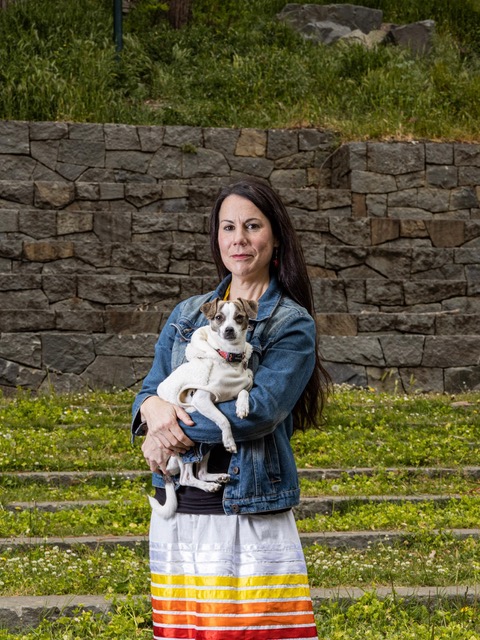
Jennifer Elise Foerster is the author of three books of poetry, most recently, The Maybe Bird, and has served as the Associate Editor of When the Light of the World Was Subdued, Our Songs Came Through: A Norton Anthology of Native Nations Poetry. She is the recipient of a 2026 Artist Grant from the Foundation for Contemporary Arts, was a Wallace Stegner Fellow, and holds a PhD in English and Literary Arts from the University of Denver. Foerster currently teaches at the Rainier Writing Workshop, Institute of American Indian Arts, and as visiting faculty at the Michener Center at UT Austin. A Mvskoke citizen, she lives in San Francisco.